Day 1 - 9/3/25: EP 37 Kawishiwi to Kivania
Having picked up our canoe at the excellent Sawtooth outfitters the night before, we got an early 6:30AM start. Shortly after leaving Tofte we encountered a mother moose and two babies galloping along Sawbill Trail, so spirits were high as we hit Kawishiwi lake around 7:30AM. Those spirits were dampened somewhat by 25 mph headwinds, whitecaps, spitting rain and temperatures in the high 30s. We are veterans of many trips, but it was daunting as our previous year's fall trip was marked by incredibly high winds that forced us off of Seagull in early October of 2024.
What followed was an absolute slog across Kawishiwi, Square, Kawasachong, Polly, Koma, Malberg and the Kawishiwi River. We repeatedly encountered deviously well-engineered beaver dams, deep keen-sucking mud on portages and wind that seemed to come straight at us regardless of our heading. The only moment of sunshine for hours was found at the end of the beautiful portage #547 from Malberg into Kawishiwi River.
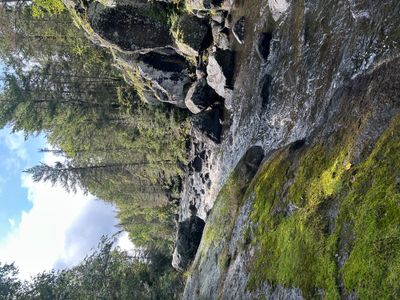
We hit Kivania around 2pm and were gratified to find the campsite (#1049) there empty so we didn't have to retreat over the portage to Kawishiwi River to the available sites there. The site on Kivania doesn't have terrific pads but is nicely elevated in the center of the lake and came with it's own set of mated swans who were completely unruffled by our presence and stayed with us the entire time we were there. The sun came out in time for us to hit Kivania and try for some walleye for dinner but sadly we could only turn up a single pike, which, although decently sized, we declined to harvest since we had our customary first night steak dinner.
Day 2 - 9/4/25: Kivania to Makwa
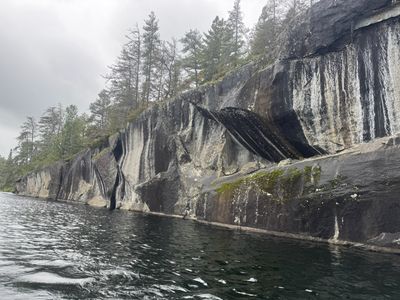
We woke early and broke camp around 8:30AM, the weather had turned for the better, though the wind cointinued to gust. The trip from Kivania to Makwa was rather unremarkable aside from some trouble locating the portage from Pan to Panhandle. We hit Makwa by 10AM and had the lake to ourselves, and in fact we would see no other humans for the next 4 days. We initially wanted to stay at the southern campsite (#985), as it's higher up on a rock promontory, but we quickly realized the entire site was far too exposed, even if the weather were not currently so volatile. We settled into the middle campsite (#983), which is fairly small and tucked into a very well-treed area just before the waist and northern, shawllower portion of the lake. It only has a couple of viable tent pads and doesn't have incredible views from the firegrate, but was much cozier and within easy striking distance of the potential trout in the main lake basin. For a lake that I have never heard described as a desitnation, Makwa is remarkable, with a towering, starkly black cliff face on the northwest shore, a smattering of small islands, and an apparently heathly population of lake trout in its deep waters. If the campsites were a little better I think it would rank highly among many people's favorite lakes, myself included. At this juncture we realized that one of our group was developing a nasty cough, so we took it easy for the rest of the day, just setting up the basecamp, exploring the lake and fishing a litlte, collecting firewood, and trying to conserve energy to bushwhack into the Humpback PMA the next day.
Day 3 - 9/5/25: Humpback PMA - Birl, Churn, Hotfoot and a little beyond
Though our man's sickness had in fact worsened overnight and a steady, discouraging rain continued to fall, we decided to suck it up and do some bushwhacking. We used the creek southwest of site #985 as the path of least resistance to reach Birl from Makwa. While it was almost ceratinly the optimal route to get in, the going was still tough. The creek becomes unfloatable rapidly and the growth is thick and low around it. Footing is very rocky as the creek ascends to the higher elevation Birl, and doesn't allow for a straight shot, but rather tracks back and forth across the hillside. Finally it ended in a smallish beaver pond that had to be forded before you got to the main lake. Probably one of the shorter bushwhacks into a PMA, but not a freebie by any means. Birl is a charming little lake, and our depthfinder never showed deeper than 25 feet. We didn't see many likely spots for a campsite as much of the northern and eastern shores are rocky with dense tree cover. Churn and Hotfoot each sit visibly higher than Birl, so that the small chain feels like descending pools down to Makwa. We were initially going to follow the water flow that comes down from Churn, but it was particularly steep and dense there with deep swampy footing. We chose to make the bushwhack at a slightly wider point to the south that allowed for a shorter, though still steep climb, and we could hand the canoe up without too much trouble. This would be a good spot for a primitive campsite as it was backed by the rocky hill for protection and had less undergrowth on solid ground. Churn is more pond than lake and didn't get deeper than 15 feet that we could find. The bushwhack into Hotfoot was made via the creek connecting it to Churn and was easier, despite being swampy and overgrown. Hotfoot is a truly serene little lake, no deeper than 20 feet by my measure, with a mostly gentle shoreline. We pushed to the western end and up the creek a short ways, then bushwhacked our way to the unnamed pool above. The undergrowth here was very dense so we decided to scout ahead without the canoe, and though the trees grew sparser farther west, the pond above was almost fully vegetated so we decided to call it the end of our journey into Humpback PMA. Easy to imagine this being the solitary domain of moose and waterfowl, with entire generations living completely free of the intrusions of man.
Above: Our first view of Birl after the bushwhack from Makwa. Paddling across BIrl. The step down between Churn and Hotfoot. Contemplating Hotfoot during a break from the rain.
Below: Creek out of Hotfoot, fevered and covered in leeches. An unnamed pool west of Hotfoot, as far West as we made it in the Humpback PMA. A small but mighty pike from Birl.
The ranger we talked to before the trip, who issued our PMA camping permit, had actually never heard of anyone entering these lakes in recent memory, nor had they ever personally issued a permit for this zone. A little suprising considering how short the initial bushwhack is, but probably because at the end of the day they are fairly unremarkable little lakes. All the same, we felt at least a little thrill of adventure and discovery on this soggy trek. We had the permit to camp but because of the continued rain and concern for our health, we decided to retreat to our site on Makwa. We ate lunch on a rock on the west end of Hotfoot during a brief break from the rain, which would make a decent campsite itself. It was then that we discovered that we were absolutely covered in leeches, dozens of leeches apiece, some small, many uncomfortably large and tenacious. We backtracked out while fishing a ilttle and found both lakes were full of small but feisty pike. Despite our best efforts, we couldn't find any other species holding in the deeper spots. Back on Makwa and flush with successful adventure and possibly fever, the rain started becoming more and more intense so we had to curtail our trout fishing and call it a day.
Day 4 - 9/6/25: Trout on Little Saganaga
Day four dawned with less rain but with unrelenting west wind and temperatures holidng in the low 40s. We decided to head up to Little Saganaga to see if we could get some lakers. We chose the two small portages at the north end of Elton (over the ~130 rod one midlake) and it proved to be an easy trip. This was my first time on Little Sag and I see why folks love it. It's big, but complex in a way that gives you a sense of security even in the high winds we were facing that day, and seemingly infinite spots to explore. Definitely a lake to hit again on a different trip. We found a couple of trout north of the island that campsite 816 is on, trolling silver and blue 4.5 inch Doctor Spoons in 35-45 feet of water. Then we found them absolutely stacked up in the passage south of that island, where the wind seemed to be pushing baitfish into the deep chokepoint the smaller island to the south. We hooked a monster and sadly lost it at the boat, but ended the jaunt with a nice eater to bring back to camp. Back at Makwa, we caught another good eating sized trout casting a smaller golden spoon into 25 feet of water between the island and shore midlake. This day ended right on cue as the heaviest rain of the trip blew in in the late afternoon and forced us off the lake, but the trout tasted incredible all the same.
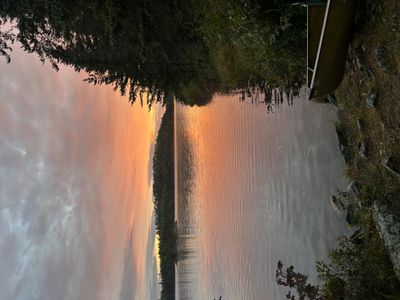
Little Saganaga and Makwa lakers, perfectly sized for the pan. And one last look south from campsite 983 at sunset.
Day 5/6 - 9/7/25: Makwa to Polly for Walleye dinner then Out
We broke camp early, around 7AM, encountered the first group since Malberg on Day 1, who must have gotten up early to meet us exiting Makwa shortly after sunrise. We made good time to Panhandle, crossed over and blithely entered the portage southbound for Pan. Turns out there was an older portage east of the current one that has grown over somewhat but not enought to seem unused. After about 40 rods we eventually figured out we were on a parallel path, maybe a couple hundred feet from the existant portage. We are single portagers still, so then had to bushwhack, fully loaded, west until we hit the real portage. This mistake is well documented if you look at the portage details on Paddle Planner, so I feel better that it hasn't just been us, but we really should have realized sooner. We wanted to be well positioned to get out early on 9/8 so we could make it back to the Twin Cities with time to spare so we pushed all the way to Lake Polly for our last night. We took the southernmost site, #2213, which would be good for a very large group as it has ample pads, though many feature spine busting roots aplenty. The put in is quite steep on the bare rock, and this was the only place we were bothered by bugs on the entire trip. Likely the wind dying down had soemthing to do with that, but the view of the island south of the site is quite nice, and we ended up finding walleye very closeby, so all in all not such a bad site. We got plenty of walleyes in the bay around the island there, casting gold husky jerks and jigging with chartreuse berkley ripple shads on 1/8 ounce jigs in 10-15 feet of water. A nice way to put a cap on our trip. The next morning we ripped back to Kawishiwi and the exit, grabbed some pies and headed for home.